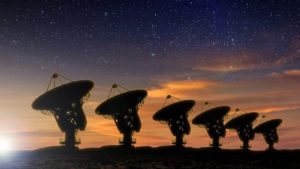
Un nuovo studio su base statistica sembra dimostrare che nel peggiore dei casi nella nostra galassia abitino almeno 36 civiltà tecnologiche in grado di comunicare, l’unico problema è la distanza tra queste civiltà che sarebbe, mediamente, di 17.000 anni luce tra l’una e l’altra. È la domanda cosmica più antica e la più grande di …
Tag: SETI
Mar 12 2018
I capricci di Tabby | MEDIA INAF
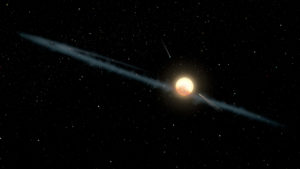
Nelle ultime settimane sono stati pubblicati due risultati astronomici che spiegano in modo “naturale” due fenomeni che erano apparsi così anomali da far pensare che ci fosse lo zampino degli extraterrestri. Ne parla Patrizia Caraveo in quest’articolo apparso ieri sul Sole24Ore, che ripubblichiamo con il consenso dell’autrice .entry-header Rappresentazione artistica dell’ipotetico anello irregolare di polvere …
Set 05 2017
Frb: in quella galassia sta accadendo qualcosa | MEDIA INAF
Le osservazioni al Green Bank Telescope di una galassia nana a tre miliardi di anni luce dalla Terra rivelano 15 fast radio bursts (Frb), lampi radio di brevissima durata. Il picco è attorno ai 7 GHz: è la prima volta che i bursts provenienti da quella galassia vengono osservati a frequenze così alte Sorgente: Frb: …
Ott 06 2016
KIC 8462852? Nessuna megastruttura aliena « MEDIA INAF
Una campagna di osservazioni ottiche dell’oggetto KIC 8462852, condotte al Boquete Optical SETI Observatory a Panama, non ha dato risultati positivi sulla eventuale presenza di megastrutture in orbita attorno alla stella. I risultati, pubblicati su ApJ Letters, suggeriscono che l’anomalia della curva di luce può essere dovuta a frammenti di una cometa che si trovano …
Feb 26 2016
Eying exomoons in the search for E.T. >> SETI
When I was young, the only planets we knew about were the ones in our own solar system. Astronomers presumed that many of the other stars in the night sky had planets too, but this was sheer speculation. We could never know for sure, the thinking went, because such planets were ridiculously small and faint. …
Feb 25 2016
Going Interstellar – SETI Institute
Imagine getting to Mars in just 3 days… or putting points beyond our solar system within our reach. New propulsion technologies could one day take us to these cosmic destinations making space travel truly interstellar! NASA 360 joins Professor Philip Lubin, University of California Santa Barbara, as he discusses his NASA Innovative Advanced Concept (NIAC) …
Gen 12 2016
Kepler marks 1,000th exoplanet discovery, uncovers more small worlds in habitable zones >> SETI Institute
Kepler has now discovered more than 100 confirmed alien planets during its second-chance K2 mission, researchers announced today (Jan. 5) here at the 227th Meeting of the American Astronomical Society (AAS). The $600 million Kepler mission launched in March 2009, tasked with determining how commonly Earth-like planets occur throughout the Milky Way galaxy. Kepler has been incredibly successful, finding …
Ott 29 2015
Maybe It’s Time To Stop Snickering About Aliens : 13.7: Cosmos And Culture : NPR
This may be the moment for all of us sober, rational, boring scientists to stop with our quick dismissals, as beyond them hides a much more interesting reality, says astrophysicist Adam Frank. Sorgente: Maybe It’s Time To Stop Snickering About Aliens : 13.7: Cosmos And Culture : NPR Gli effetti del Viagra http://cialisgenericotrovaprezzi.com/cialis-generico-miglior-prezzo-piu-basso/
Ott 01 2015
NASA Selects Investigations for Future Key Planetary Mission >> NASA
NASA has selected five science investigations for refinement during the next year as a first step in choosing one or two missions for flight opportunities as early as 2020. The submitted proposals would study Venus, near-Earth objects and a variety of asteroids. Sorgente: NASA Selects Investigations for Future Key Planetary Mission | NASA Il fatto …